My research has resulted in peer-reviewed publications, conference presentations, and a master's thesis focused on cardiac tissue engineering. Below are selected works that demonstrate my ability to communicate complex scientific concepts and contribute to the broader understanding of cardiovascular disease mechanisms.
Master's Thesis
"Modeling of Hypertrophic Cardiomyopathy Using Genome-Edited Human Induced Pluripotent Stem Cell-Derived Cardiomyocytes with Dynamic Mechanical Stimulation"
University of North Texas, March 2023
Developed a novel stretcher platform to model hypertrophic cardiomyopathy (HCM) in vitro using genome-edited hiPSC-derived cardiomyocytes. Investigated how mechanical strain affects calcium handling dynamics in cells with MYBPC3 mutations—one of the most common genetic causes of HCM. This work bridges tissue engineering with disease modeling, demonstrating how biomechanical forces contribute to cardiac dysfunction and providing a scalable platform for drug screening and mechanistic studies.
Peer-Reviewed Publication
"Current Methods for Fabricating 3D Cardiac Engineered Constructs"
Rogozinski, N., Yanez, A., Bhoi, R., Lee, M.Y., Yang, H. iScience 25(5):104330, 2022
Comprehensive review examining advanced fabrication methods for creating 3D cardiac tissue constructs that replicate both healthy and diseased myocardium. Highlights how stem cell technology, biomaterials, and bioprinting techniques enable personalized disease modeling and therapeutic development for patients with heart failure. Addresses the critical need for region-specific cardiac tissue models that capture the complexity of native heart tissue.
Book Chapter
"Non-obstructive Methods to Detect Sarcomere Remodeling of Live In Vitro Cardiomyocytes"
Rogozinski, N., Velez, S., Hong, Y., Yang, H. In: Liao, J., Wong, J.Y. (eds) Integration and Bridging of Multiscale Bioengineering Designs and Tissue Biomechanics. Springer, 2025
Comprehensive review of state-of-the-art sarcomere imaging techniques for studying cardiac remodeling in live cells. Explores non-invasive approaches to visualize and quantify sarcomere dynamics in disease modeling, drug development, and validation of engineered cardiac constructs. Highlights how advanced imaging technologies enable real-time observation of the contractile machinery's response to pathological conditions without disrupting cellular function.
Additional publications
Taylor, A., Xu, J., Rogozinski, N., Fu, H., Molina Cortez, L., McMahan, S., ... & Hong, Y. (2024). Reduced graphene-oxide-doped elastic biodegradable polyurethane fibers for cardiomyocyte maturation. ACS biomaterials science & engineering, 10(6), 3759-3774.
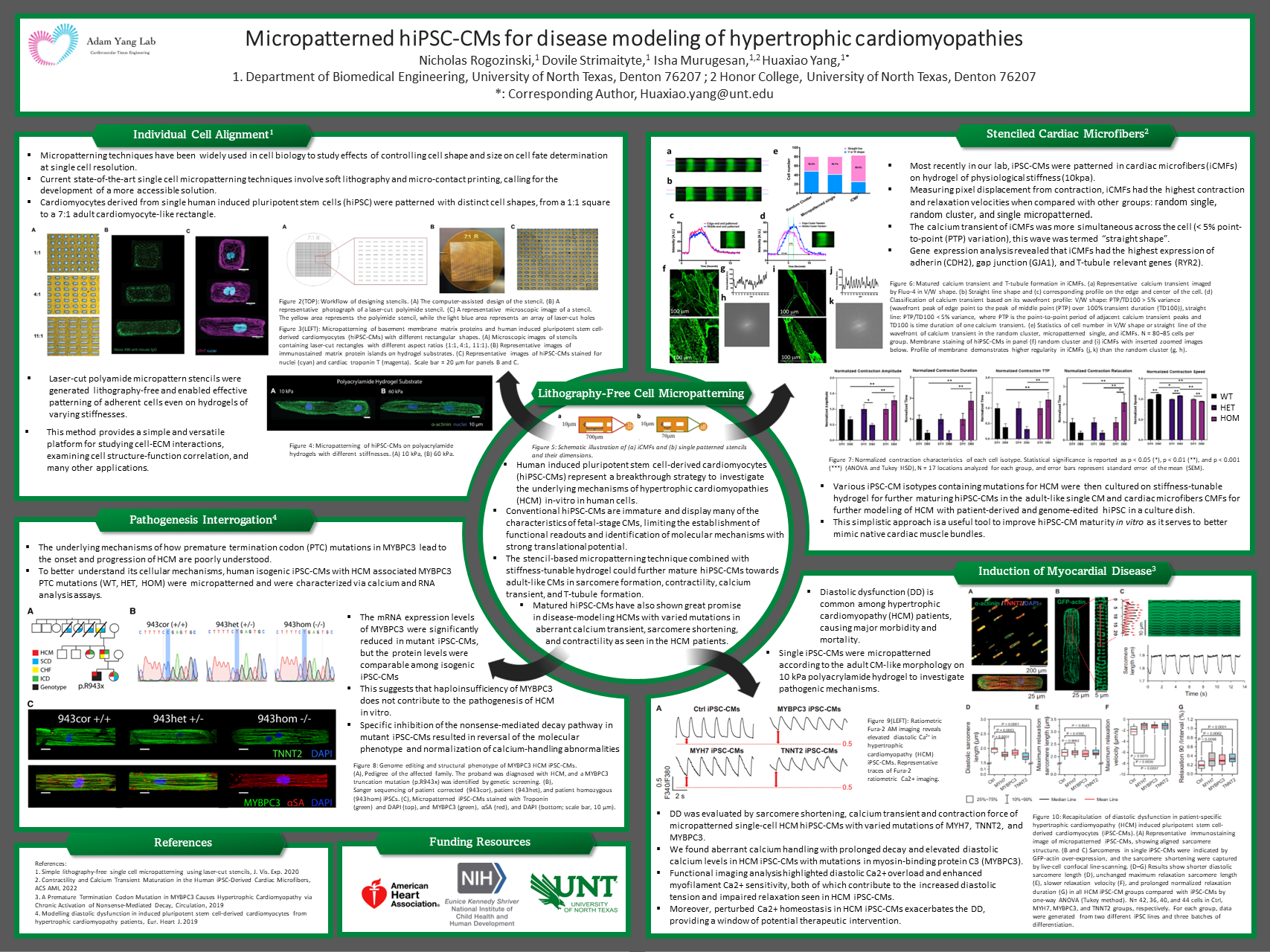
Below is a poster I had the opportunity to develop and present at the BMES 2022 Annual meeting.
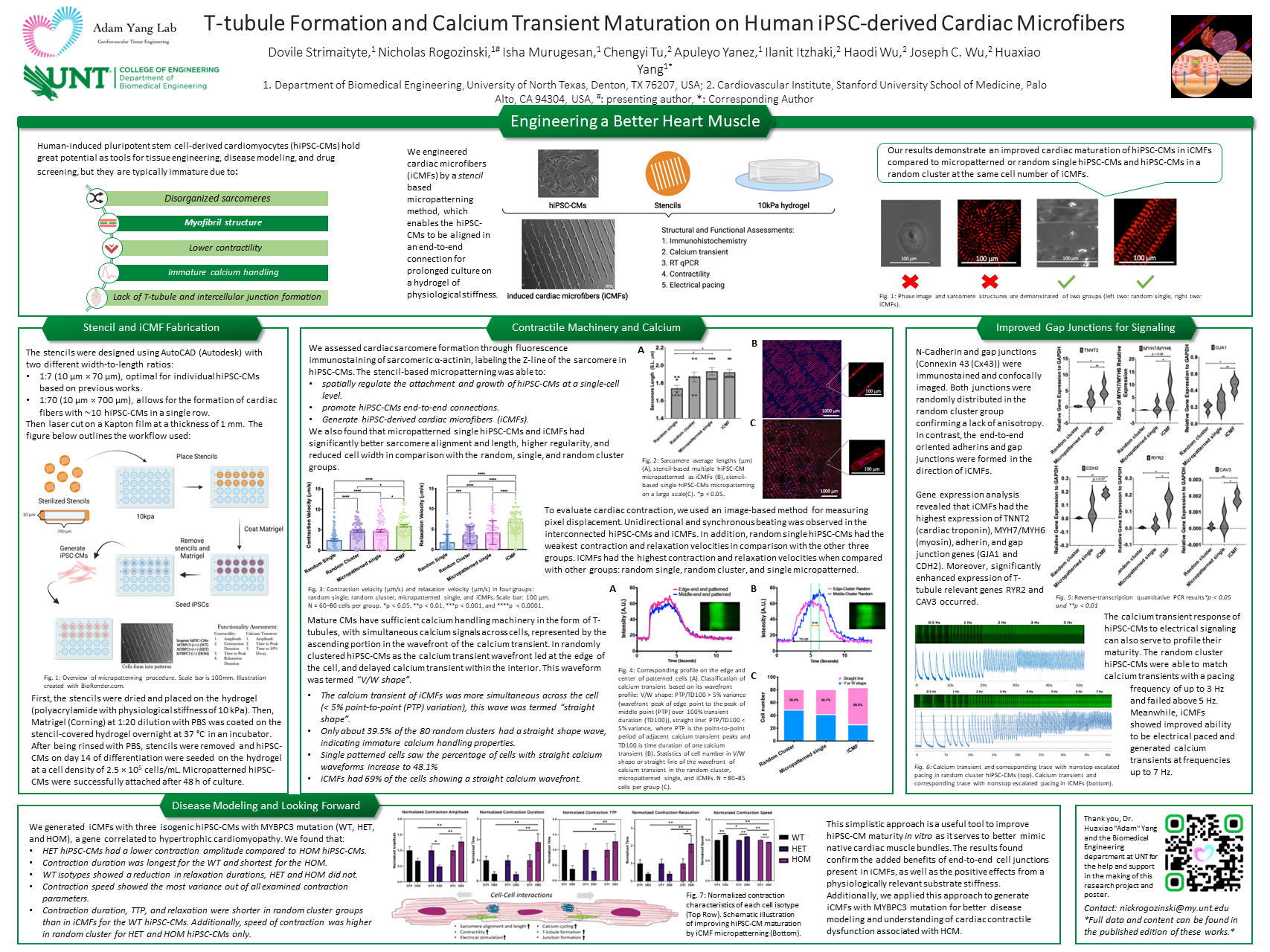
Poster was on display at the Society for Biomaterials Annual Meeting 2023 in San Diego, CA.